Feb 6 / Copper Age: Regional Rituals


Timeline 


  • First Hominins Period:  The earliest, dating 7-6 million years ago.
  •  
  • Early Hominins Period: From 2.7 - 1.5 million years ago.
  • Paleolithic Period: Roughly from 2.5 million years ago to 10,000 B.C.
  • Neolithic Period: From around 4300 BC down to 2000 BC

Indigenous Caribbean 1492 AD (Spider web idea)

Syncretic Caribbean  2022 AD (Spider web idea)

  •  Copper or Chalcolithic Age: 3500 to 2300 BCE.


I

Unit: Copper Age

Theme: Ritual Practices


Introduction

The Chalcolithic or Copper Age is the transitional period between the Neolithic and the Bronze Age. It is taken to begin around the mid-5th millennium BC, and ends with the beginning of the Bronze Age proper, in the late 4th to 3rd millennium BC, depending on the region. Furthermore, it is an archaeological period characterized by regular human manipulation of copper, but prior to the discovery of bronze alloys.


II

Learning Objectives


  •  Understand the importance of the discovery of copper
  •  Explain the relationship between sedentary life, regional cults and rituals
  • Gather an awareness of the influence that the discovery of smelting ore had on the production of music in Egypt's Copper Age.
  •  Experience the reproduction of the movements represented in the chosen illustrations.


III

 Main Lesson


1

 Read and Discuss

The Roots of Theatre: Rethinking Ritual 

 https://www.jstor.org/stable/j.ctt20q1xvq

These 17 chapters and introduction by Eli Rozic discuss ritual within the context of the origin of theater.  There are 6 groups in the class. Each group will discuss 3 of the cited books and share with the class.

Question 1

What is the relationship between theater and ritual in your particular chapters?


 2

Copper Age

Link: 

https://draft.blogger.com/blog/post/edit/1576925318821129707/8788887432996039976


(3:15 - 22:37)

After watching this video:

Question 2

Why was the discovery of copper an important aspect in the development of human society? 

 the relationship between sedentary life, regional cults and rituals


2


(Min. 24:30 - 41:25)

After watching this video, explain in your own words:

Question 3

What do you think is the relationship between sedentary life, regional cults and rituals?

 -----------------


IV

A Note to Remember


The idea that there was a Copper Age between the Neolithic and Bronze Age was inspired by the discovery of copper use in prehistoric North America. 

Its currency in European prehistory owes much to the 1861 observations by William Wilde that copper artifacts preceded bronze tools in Ireland, though he himself did not postulate a Copper Age per se. 

Acceptance of the existence of a Copper Age was a long process, not least as it seemed to contradict the premises of the Three Age System and was conflated with arguments for the local development of copper metallurgy, but the 1876 and 1880 international prehistoric archaeology congresses were key moments in its recognition. 

By the mid-1880s its validity was widely accepted in Europe. In contemporary dating schemes, the definition of the Copper Age varies according to regional and national traditions. 


V

Case Study


The Evolution of Finger Cymbals

 by Dawn Devine – Davina

Scholars of dance love to theorize on the origins of our art form. We contemplate the regions that may have given rise to unique body motions or the cultures that developed different musical styles.  But there is one component of our dance that has been definitively proven to date back to pre-literate antiquity.  These are our much beloved favorite music instrument, the mighty finger cymbal.  

Copper Age

Our journey begins back in the 4th millennium or 3000 BCE.  It’s a time when our ancestors were still making music with wooden clappers, skinned drums, and simple stringed instruments which rarely survive. 

The smallest, most portable, and easiest to make instruments were simple concussive idiophones. This is a category of musical instruments that produce resonant sound from the intrinsic property of the item. 

Our forbearers used materials such as wooden sticks, lengths of ivory or bone, and precious stones to produce pleasing resonant sounds to their ears.

 The discovery of smelting ore, and humankind’s first practical metal, copper, allowed people to craft stronger and more practical work tools, kitchen utensils, and weapons. 

It also added a new material for making musical instruments.  Some of the earliest finger cymbals are made from copper or simple copper alloys.  Examples of these earliest instruments survive because of their value and importance in daily life. 

They have been found in the graves of wealthy and important individuals ranging from Anatolia (modern Turkey) around the Eastern Mediterranean to Egypt.  

Egyptian Finger Cymbals of Copper Alloys and Bronze, 1000 BCE – 500 CE Louvre Exhibit, Alisha Westerfeld

Source:

 https://draft.blogger.com/blog/post/edit/1576925318821129707/8788887432996039976


 Question 4

How did the discovery of smelting ore influence the production of music in Egypt's Copper Age?


VI


Activity


Students get in group (one per illustration) and reproduce the movements represented in the chosen illustration. Then, they put them together in a phrase that they will share with the rest of the class.


The Dance: Historic Illustrations of Dancing 


from 3300 B.C. to 1911 A.D.

BY
AN ANTIQUARY

LONDON
JOHN BALE, SONS & DANIELSSON, LTD.
83-91, GREAT TITCHFIELD STREET, OXFORD STREET, W
Respectfully dedicated to Dr. Eleanor Maxwell.

1911

   https://www.gutenberg.org/files/17289/17289-h/17289-h.htm


1

Amongst the earliest representations that are comprehensible, we have certain Egyptian paintings, and some of these exhibit postures that evidently had even then a settled meaning, and were a phrase in the sentences of the art. Not only were they settled at such an early period (B.C. 3000, fig. 1);

Fig. 1


------------------------------------------------------------------------

2

they appear to have been accepted and handed down to succeeding generations (fig. 2). The accompanying illustrations from Egypt and Greece exhibit what was evidently a traditional attitude. The hand-in-hand dance is another of these [traditional attitudes]. The earliest accompaniments to dancing appear to have been the clapping of hands, the pipes, the guitar, the tambourine, the castanets, the cymbals, the tambour, and sometimes in the street, the drum. 

 "The dresses of the females were light and of the finest texture, a loose flowing robe reaching to the ankles, sometimes with a girdle.

"In later times, it appears more transparent and folded in narrow pleats. Some danced in pairs, holding each other's hand; others went through a succession of steps alone, both men and women; sometimes a man performed a solo to the sound of music or the clapping of hands. 

The following account of Egyptian dancing is from Sir Gardiner Wilkinson's "Ancient Egypt."

"The dance consisted mostly of a succession of figures, in which the performers endeavored to exhibit a great variety of gesture. Men and women danced at the same time, or in separate parties, but the latter were generally preferred for their superior grace and elegance. Some danced to slow airs, adapted to the style of their movement; the attitudes they assumed frequently partook of a grace not unworthy of the Greeks; and some credit is due to the skill of the artist who represented the subject, which excites additional interest from its being in one of the oldest tombs of Thebes (B.C. 1450, Amenophis II.).


Fig. 2


 -------------------------------------------------------------------


3

Others preferred a lively step, regulated by an appropriate tune; and men sometimes danced with great spirit, bounding from the ground, more in the manner of Europeans than of Eastern people. On these occasions the music was not always composed of many instruments, and here we find only the cylindrical maces and a woman snapping her fingers in the time, in lieu of cymbals or castanets. 

Fig. 3: The hieroglyphics describe the dance.
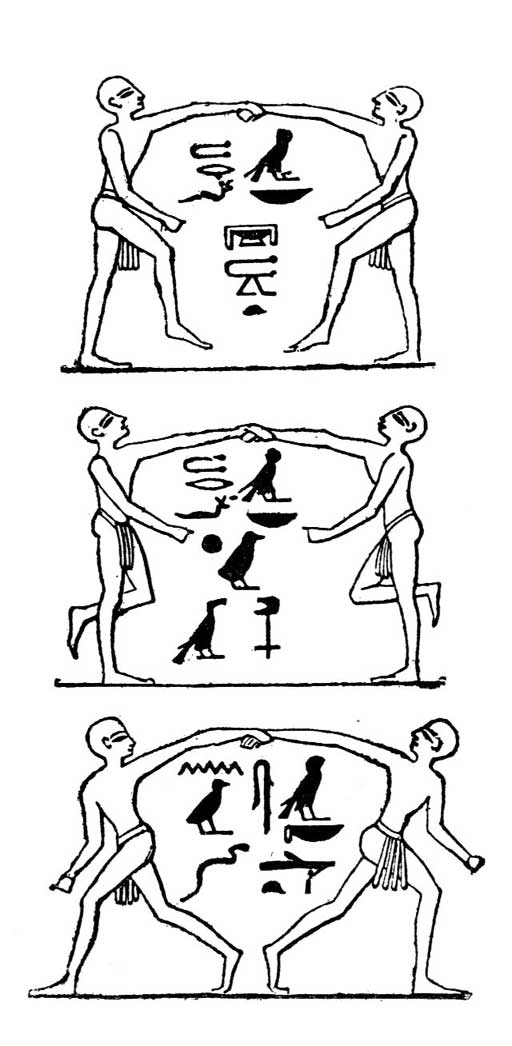
In later times, it appears more transparent and folded in narrow pleats. Some danced in pairs, holding each other's hand; others went through a succession of steps alone, both men and women; sometimes a man performed a solo to the sound of music or the clapping of hands. "A favourite figure dance was universally adopted throughout the country, in which two partners, who were usually men, advanced toward each other, or stood face to face upon one leg, and having performed a series of movements, retired again in opposite directions, continuing to hold by one hand and concluding by turning each other round (see fig. 3)

The hieroglyphics describe the dance.  

Fig.  3


 ------------------------------------------------------------


4

"Graceful attitudes and gesticulations were the general style of their dance, but, as in all other countries, the taste of the performance varied according to the rank of the person by whom they were employed, or their own skill, and the dance at the house of a priest differed from that among the uncouth peasantry, etc.

"It was not customary for the upper orders of Egyptians to indulge in this amusement, either in public or private assemblies, and none appear to have practiced it but the lower ranks of society, and those who gained their livelihood by attending festive meetings.

"Fearing lest it should corrupt the manners of a people naturally lively and fond of gaiety, and deeming it neither a necessary part of education nor becoming a person of sober habits, the Egyptians forbade those of the higher classes to learn it as an amusement.

"Many of these postures resembled those of the modern ballet, and the pirouette delighted an Egyptian party 3,500 years ago. 

That the attitude was very common is proved by its having been adopted by the hieroglyphic (fig. 4) as the mode of describing 'dance.'"

Many of the positions of the dance illustrated in Gardner Wilkinson are used at the present day.
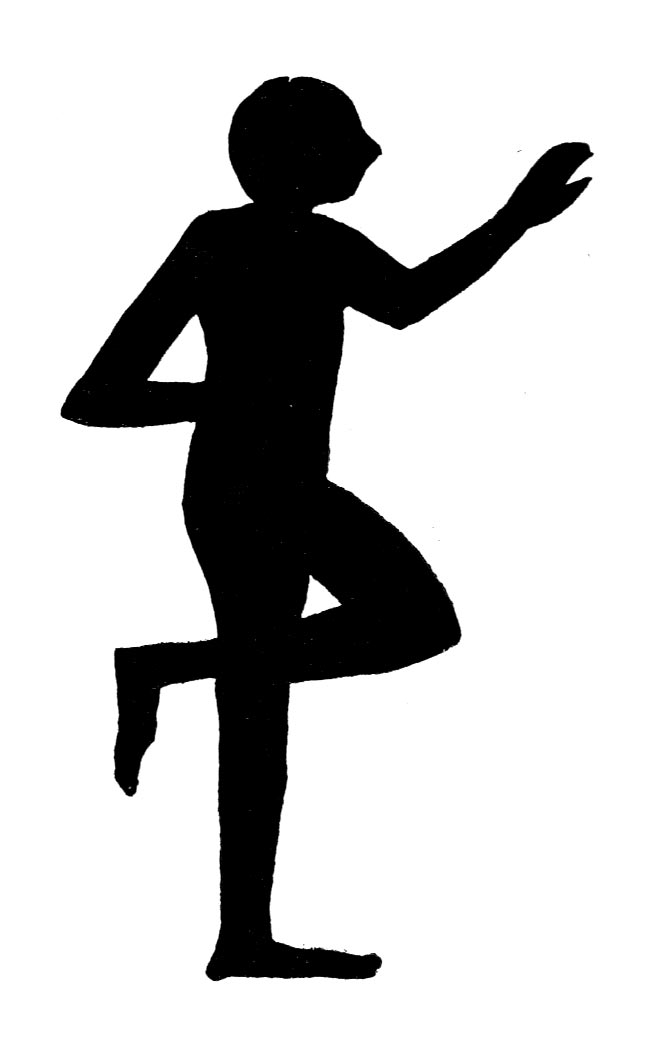
 

Egyptian hieroglyphic for 'dance.'
 
Fig. 4: Egyptian hieroglyphic for "dance."


----------------------------------------------------------------------------------------
 
5
 
 The ASSYRIANS probably danced as much as the other nations, but amongst the many monuments that have been discovered there is little dancing shown, and they were evidently more proud of their campaigns and their hunting than of their dancing. A stern and strong people, although they undoubtedly had this amusement, we know little about it. Of the Phoenicians, their neighbours, we have some illustrations of their dance, which was apparently of a serious nature, judging by the examples which we possess, such as that (fig. 5) from Cyprus representing three figures in hooded cowls dancing around a piper. It is a dance around a centre,


5

(5:20)


--------------------------------------------------------------------------


6


 It is a dance around a centre, as is also (fig. 6) that from Idalium in Cyprus. The latter is engraved around a bronze bowl and is evidently a planet and sun dance before a goddess, in a temple; the sun being the central object around which they dance, accompanied by the double pipes, the harp, and tabour. The Egyptian origin of the devotion is apparent in the details, especially in the lotus-smelling goddess (marked A on fig. 6) who holds the flower in the manner shown in an Egyptian painting in the British Museum (fig. 7). 

6
 

-----------------------------------------------------------------------------------------


7

From the Phoenicians we have illustrated examples, but no record, whereas from their neighbours the Hebrews we have ample records in the Scriptures, but no illustrations. It is, however, most probable that the dance with them had the traditional character of the nations around them or who had held them captive, and the Philistine dance (fig. 6) may have been of the same kind as that around the golden calf (Apis) of the desert (Exodus xxxii. v. 19).


7


----------------------------------------------

8


8


Music


Music Source: https://hellomusictheory.com/learn/egyptian-instruments/


Question 5

Reflect on your overall experience and write about it. Post your reflection on Discussion Board.


VII


Journaling


VIII
 
Glossary 

girdle: A girdle is a form-fitting foundation garment that encircles the lower torso, extending below the hips, and worn often to shape or for support. It may be worn for aesthetic or medical reasons. In sports or medical treatment, a girdle may be worn as a compression garment. 
 
Sir John Gardner Wilkinson: He was an English traveler, writer and pioneer Egyptologist of the 19th century. He is often referred to as "the Father of British Egyptology."
 
 Idalium: Idalion or Idalium was an ancient city in Cyprus, in modern Dali, Nicosia District. The city was founded on the copper trade in the 3rd millennium BC.
 
Assyrians: Assyrians are an indigenous ethnic group native to Mesopotamia, a geographical region in West Asia. Modern Assyrians descend from Ancient Mesopotamians such as ancient Assyrians and Babylonians.
 
Phoenicians: Phoenicia, or Phœnicia, was an ancient Semitic thalassocratic civilization originating in the coastal strip of the Levant region of the eastern Mediterranean, primarily located in modern Lebanon
 
thalassocratic: A thalassocracy or thalattocracy, sometimes also maritime empire, is a state with primarily maritime realms, an empire at sea, or a seaborne empire. Traditional thalassocracies seldom dominate interiors, even in their home territories.
 
Philistines: The Philistines were an ancient people who lived on the south coast of Canaan during the Iron Age in a confederation of city-states generally referred to as Philistia. The Philistines originated as an immigrant group from the Aegean that settled in Canaan circa 1175 BC during the Late Bronze Age collapse.

IX

Sources

An Antiquary (1911). The Dance: Historic Illustrations of Dancing from 3300 B.C. to 1911 A.D. London: John Bale, Sons & Danielsson, Ltd. 83 - 91, Great Titchfield Street, Oxford Street, W. https://www.gutenberg.org/files/17289/17289-h/17289-h.htm

 
X
 
Student's Work 
 
Bradley Merschman
Copper age regional rituals make up

Question 1
What is the relationship between theater and ritual in your particular chapters?
Theater has its roots in ritual practices. Rituals were not just religious ceremonies but acted as early forms of performance where participants used gestures, music, dance, and storytelling to communicate with the divine or the community. These structured, symbolic actions eventually evolved into more formalized theater.

Question 2
Why was the discovery of copper an important aspect in the development of human society?
The discovery of copper was significant because it allowed humans to create stronger and more durable tools, weapons, and utensils compared to stone. This technological advancement supported the development of settled (sedentary) communities, which in turn led to the growth of specialized religious practices (regional cults) and organized rituals, marking a major step in societal complexity.

Question 3
What do you think is the relationship between sedentary life, regional cults, and rituals?
Sedentary life meant people stayed in one place, forming communities. As communities grew, they developed unique cultural and religious practices (regional cults). Rituals became important as regular, communal activities that reinforced social bonds, marked important events, and honored deities or natural forces tied to their particular region.

Question 4
How did the discovery of smelting ore influence the production of music in Egypt's Copper Age?
Smelting ore enabled the creation of copper and copper alloy instruments like finger cymbals. These instruments produced more resonant and lasting sounds compared to earlier wood or bone instruments. Music became more sophisticated and durable, playing a vital role in rituals, ceremonies, and daily entertainment, particularly in Egypt.

Question 5
Reflect on your overall experience and write about it.
Learning about the Copper Age opened my eyes to how much a single discovery like copper smelting shaped human culture. It didn't just change tools and weapons—it transformed music, dance, rituals, and even helped lead to theater. Reproducing ancient dance movements helped me feel a closer connection to the people of that time, understanding how art and ritual were deeply woven into their lives. It's amazing how the earliest communities laid the foundation for the complex cultures we know today.


 Ann Ceballos

The Roots of Theatre: Rethinking Ritual

Question 1

What is the relationship between theater and ritual in your particular chapters?

- In the chapters from "The Roots of Theatre: Rethinking Ritual," the relationship between theater and ritual is essential for understanding performance origins. Both serve as expressions of human experience and often stem from cultural and spiritual practices. The chapters show how early theater emerged from rituals, using storytelling to convey communal values. Rituals create transformative spaces, allowing deep engagement with themes, similar to theater. Techniques like repetition and symbolism in rituals mirror those in theatrical performances, enhancing audience connection. Overall, these chapters highlight that theater evolved from rituals, maintaining their core elements while adapting to modern forms.


Copper Age 

Question 2

Why was the discovery of copper an important aspect in the development of human society? the relationship between sedentary life, regional cults and rituals

- The discovery of copper was crucial in human society's development because it marked the shift from the Stone Age to the Metal Age, leading to stronger tools and weapons. This improvement boosted agriculture and hunting, enabling communities to settle in one place. With sedentary life, regional cults and rituals emerged, reflecting the new social dynamics. As people established permanent settlements, they developed complex social structures and cultural practices centered around agriculture, fertility, and seasonal changes. Rituals became important for marking life events and fostering community bonds, ultimately enhancing social cohesion. As a result, copper not only advanced technology but also facilitated the growth of stable, culturally rich societies.


Question 3

What do you think is the relationship between sedentary life, regional cults and rituals?

The relationship among sedentary life, regional cults, and rituals is vital. As communities shifted to a sedentary lifestyle, they created permanent settlements that encouraged the development of social structures and cultural practices.


Question 4

How did the discovery of smelting ore influence the production of music in Egypt's Copper Age?

- The discovery of smelting ore during Egypt's Copper Age greatly impacted music production. It enabled the creation of more durable instruments, like bronze cymbals and bells, which improved sound quality and expanded the range of musical options. Additionally, advancements in metalworking allowed for more precise crafting of instruments, increasing variety in musical tools. As communities settled, music became a key part of cultural and religious rituals, with enhanced instruments playing a central role in ceremonies and celebrations. Overall, smelting not only improved instrument quality but also elevated music's significance in society. The discovery not only improved the quality of musical instruments but also increased the role of music in cultural and social practices. 


Question 5
Reflect on your overall experience and write about it.

Reflecting on the historic illustrations of dancing during the Copper Age, I was struck by the deep connection between dance and cultural expression. The visuals reveal how dance served as a form of communication and storytelling, integral to rituals and social gatherings. It was fascinating to see the diversity of styles, highlighting how different cultures expressed their identities through movement. The energy and emotion captured in these illustrations made the historical context feel more relatable. Overall, this exploration enhanced my understanding of dance's cultural significance in the Copper Age and its lasting impact. It reinforced the idea that dance is a universal language that transcends time, inspiring me to further examine the relationship between dance and community in various historical contexts.


Simone Lantier

  1. The chapter discusses the relationship between theatre and ritual, with the focus on the debate about whether Greek tragedy had its origins in ritual or not. Scholars like Jane Harrison and Gilbert Murray have claimed that tragedy developed from Dionysian rituals, especially dithyrambic choral storytelling, whereas A. W. Pickard-Cambridge had problems with this view because there was no direct evidence. It finally suggests that although early theatrical forms may have been influenced by ritual, tragedy and theatre became separate artistic forms instead of being mere extensions of religious ceremonies.

  2. The discovery of copper was significant because it led to the advancement from the use of stone tools to the development of metalworking, and thus better and more complicated tools, weapons and art. This innovation was rather closely connected to sedentary life as established villages like Çatalhöyük had the time and manpower to engage in metallurgical experiments. Copper usage was also related to the formation of regional cults and rituals. Metal objects were signs of status, were used for religious purposes and were included in burial ceremonies to maintain social hierarchies as well as cultural identities.

  3. Leading a sedentary life made regions develop settlement systems which in turn created a shared identity and the need for a unified belief system. Regional cults and rituals developed as communities grew to reinforce social cohesion, mark territorial boundaries and to facilitate resource sharing. The construction of temples, the creation of ritual artifacts, and the establishment of communal burial practices demonstrate how religion was a key part of ordering and identifying in these early societies.

  4. The ability to smelt ore in the Copper Age enhanced the strength and toughness of tools, including musical instruments. In Egypt, this resulted in the manufacture of early finger cymbals of copper and simple copper alloys. The metal instruments produced resonant sounds and were rich enough to be entombed with important individuals, indicating their importance in music and daily life.


Comments

Popular posts from this blog

Feb 13 / Review / Mid-term

Jan 23 / The Labyrinth: The Dancer

Jan 21 / Homonins: The Oldest Human Rituals